


A Stair Runner Carpet covers the central section of a staircase while leaving part of the timber, stone, or painted stair tread visible along both sides. This type of carpet installation creates a balance between exposed architectural materials and the softer appearance of textile flooring. It can reduce footstep noise, introduce color and pattern, protect frequently used areas of the stairs, and visually connect different levels of a home.
Unlike a rug placed on a flat floor, a Stair Runner Carpet must follow a three-dimensional surface made up of treads, risers, nosings, landings, and sometimes curved or angled steps. Because stairs receive concentrated daily traffic, careful attention should be given to dimensions, carpet construction, pattern alignment, installation method, and maintenance.
What Does a Stair Runner Carpet Add to a Staircase?
Staircases are often important architectural features, but bare timber, stone, or painted steps can sometimes appear visually hard or disconnected from surrounding rooms. A Stair Runner Carpet introduces a continuous textile surface that guides the eye from one floor to another.
Because the outer edges of the staircase remain visible, the original stair material can still contribute to the interior design. Timber treads, decorative finishes, or contrasting paint colors can remain part of the overall appearance rather than being completely covered.
A Stair Runner Carpet can also provide several practical benefits:
- It can soften the sound of footsteps on hard stair surfaces.
- It adds a warmer and softer surface underfoot.
- It protects the central section of stair treads from concentrated wear.
- It introduces pattern, color, and texture into narrow transitional spaces.
- It can create visual continuity between upstairs and downstairs interiors.
A properly selected and securely installed Stair Runner Carpet may also improve traction compared with some smooth stair surfaces. However, carpet alone does not eliminate the possibility of falls. Good lighting, secure handrails, clear stair edges, suitable step dimensions, and correct installation remain important parts of staircase safety.
Choosing the Correct Stair Runner Carpet Width
Width has a major influence on the appearance of a Stair Runner Carpet. A narrower design exposes more of the staircase material on both sides, creating a stronger contrast between carpet and stair tread. A wider design provides greater textile coverage and creates a softer overall appearance.
The ideal width depends on the total staircase width, the balustrade design, the surrounding architecture, and the desired visual proportion.
For a straight staircase, the exposed border on the left and right sides should normally appear consistent from the bottom step to the top. If the staircase changes width, every section should be measured individually rather than assuming that one measurement applies to the entire installation.
Curved, winding, or pie-shaped stairs require additional planning. Because these stair treads are not rectangular, the visible border may change unless the Stair Runner Carpet is carefully positioned and shaped.
Selecting a Durable Material for a Stair Runner Carpet
Stairs concentrate pressure along a relatively narrow walking path, especially near the front edge of every tread. For this reason, a Stair Runner Carpet should be made from a construction suitable for repeated use.
Dense carpet structures generally maintain their appearance better than loose or extremely soft surfaces. The material should also bend securely around stair nosings without creating excessive thickness or unstable edges.
Wool is frequently used for Stair Runner Carpet applications because it offers resilience, comfortable texture, and a refined appearance. Wool fibers can recover relatively well after compression, which is useful on steps exposed to repeated foot traffic.
Wool blends may combine natural texture with additional performance characteristics. Synthetic fibers can also provide consistent color and practical maintenance, although performance varies according to fiber quality, density, backing, and manufacturing method.
Pile construction is another important consideration. Large or loosely constructed loops may be more vulnerable to catching on footwear, pet claws, or objects being carried upstairs. Tight, low loop structures may be appropriate when the product is specifically designed for stair installation.
Cut-pile carpet provides a smoother surface and can create a clean appearance. However, extremely deep pile may reduce pattern definition and create additional movement around stair edges.
Before installation, product specifications should confirm that the selected carpet is suitable for use on stairs.
How Pattern Direction Affects Stair Runner Carpet Design
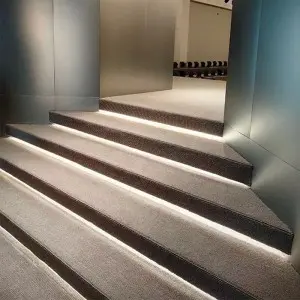
Pattern behaves differently on stairs than it does on a flat floor. On a Stair Runner Carpet, part of the design appears horizontally across each tread, another section appears vertically on each riser, and the pattern bends around every nosing.
For this reason, a pattern that appears continuous on a flat sample may look very different once installed on a staircase.
Striped Stair Runner Carpet designs are popular because vertical lines can emphasize the upward direction of a staircase. Precise alignment is especially important because even a small shift in the stripe can become increasingly visible over multiple steps.
Geometric designs also require careful centering. Squares, diamonds, borders, and repeated linear motifs can make minor alignment errors easier to notice.
Floral, abstract, distressed, or organic patterns may provide greater flexibility because small variations are often less obvious.
Pattern repeat must also be considered when calculating material quantity. Additional carpet may be required to maintain consistent motif positioning between stair sections, especially when the staircase includes a landing or changes direction. Large pattern repeats may increase material requirements because sections sometimes need to be adjusted before the design aligns correctly.
Installation Styles for Stair Runner Carpet
The installation method influences both the appearance and performance of a Stair Runner Carpet. Two commonly used approaches are waterfall installation and French-cap installation.
With the waterfall method, the Stair Runner Carpet passes over the front edge of the tread and continues more directly down the riser. This creates a relatively simple profile and can work well with many contemporary and casual interiors.
French-cap installation creates a more fitted appearance. The Stair Runner Carpet follows the contour of the stair nosing more closely before being secured against the riser. This emphasizes the shape of each step and produces a more tailored architectural effect.
The suitable installation method depends on several factors, including carpet thickness, backing construction, staircase profile, pattern, and desired appearance.
Very thick or rigid carpets may be more difficult to form tightly around detailed stair edges. Pattern alignment may also behave differently depending on how the material is wrapped around the nosing.
Professional installation is particularly important because loose edges, poor tension, or inaccurate fixing can affect both appearance and practical use.
Coordinating Stair Runner Carpet Colors With Interior Design
A Stair Runner Carpet often connects two or more areas of a home, so its color should work with both levels rather than only with the staircase itself.
Neutral colors such as beige, gray, cream, taupe, and brown can create a subtle transition between spaces. Darker shades may create strong contrast against pale timber or painted stairs, while lighter colors can give narrow staircases a more open appearance.
Patterned designs provide additional opportunities to connect different interior colors. For example, a Stair Runner Carpet can repeat tones found in wall paint, furniture, curtains, or flooring on different levels of the home.
Strong geometric patterns can turn the staircase into a visual feature, while subtle tonal patterns maintain a quieter appearance.
Conclusion
A Stair Runner Carpet can combine the comfort of textile flooring with the architectural character of an exposed staircase. It can soften footsteps, introduce color and pattern, protect heavily used sections of stair treads, and create visual continuity between different levels of a building.
Successful results depend on more than choosing an attractive carpet. Accurate measurements, stair-appropriate materials, controlled pattern alignment, suitable pile construction, professional installation, and regular maintenance all contribute to long-term performance.
By treating the staircase as a three-dimensional architectural surface rather than a simple flat floor, a Stair Runner Carpet can become an integrated design feature that remains practical and visually balanced under everyday use.
Frequently Asked Questions
1. How wide should a Stair Runner Carpet be?
The appropriate width depends on the overall staircase dimensions and the amount of exposed stair surface desired on both sides. The Stair Runner Carpet should provide a comfortable central walking area while maintaining balanced and consistent side borders.
2. Is every type of carpet suitable for a Stair Runner Carpet?
No. A Stair Runner Carpet should use material suitable for stair installation and repeated foot traffic. Extremely loose loops, very deep pile, unsuitable backing, or weak construction may not perform well around stair nosings.
3. Can a Stair Runner Carpet improve staircase safety?
A securely installed Stair Runner Carpet with suitable surface texture may improve traction compared with some smooth surfaces, but it cannot eliminate fall risk. Handrails, lighting, stair dimensions, clear walking areas, and correct installation remain important.
4. What is the difference between waterfall and French-cap Stair Runner Carpet installation?
Waterfall installation allows the Stair Runner Carpet to flow over the stair nosing and continue more directly down the riser. French-cap installation fits the carpet closely around the nosing, creating a more tailored and defined profile.
Post time: Aug-07-2026


