


A Hand Tufted Wool Rug combines the natural character of wool with a production method that allows freedom in pattern, color, shape, and surface texture. Unlike a standard machine-made floor covering, a Hand Tufted Wool Rug can be developed around a particular interior concept, furniture arrangement, or visual identity. The process can support geometric compositions, carved details, contrasting pile heights, and custom dimensions.
Its appearance depends on more than artwork. Wool quality, yarn thickness, tufting density, pile construction, backing, finishing, and carving all influence how the final surface feels and performs.
How a Hand Tufted Wool Rug Is Made
A Hand Tufted Wool Rug is produced by inserting yarn through a primary backing that has been stretched on a frame. A tufting tool pushes the yarn through the backing to build the design section by section. The surface may be created as cut pile, loop pile, or a combination of both depending on the intended texture.
After tufting, the yarns are secured from the back with an adhesive or latex system, and a secondary backing is commonly added to protect the structure and create a finished underside. The face of the Hand Tufted Wool Rug may then be trimmed, leveled, carved, or sculpted to improve clarity between colors and shapes.
This construction is different from hand-knotting. A hand-knotted rug is built by tying individual knots around warp threads, while a Hand Tufted Wool Rug uses inserted tufts that are secured by the backing system. The difference affects production method, structure, repair considerations, and the appearance of the reverse side.
Why Wool Works Well in Hand Tufting
Wool is valued in a Hand Tufted Wool Rug because it can provide softness, resilience, and a substantial surface. Its natural crimp helps wool yarn recover after compression, which is useful where furniture or foot traffic places repeated pressure on the pile. Wool can also produce rich color, although final appearance depends on dyeing method, yarn structure, and lighting.
Different yarn preparations create different results. Finer yarn can support detailed patterning, while heavier yarn may create a bolder, more tactile surface. Yarn twist also affects definition and texture, so the yarn itself should be treated as part of the design.
A Hand Tufted Wool Rug may release some loose surface fibers during early use as the pile settles. Maintenance should follow the product instructions, because aggressive pulling or brushing can damage the surface.
Density, Pile Height, and Surface Character
Tufting density determines how closely yarn is packed across a Hand Tufted Wool Rug. Higher density can create a fuller surface and support clearer carving, while lower density may produce a lighter construction. Density should be considered together with yarn thickness and pile height.
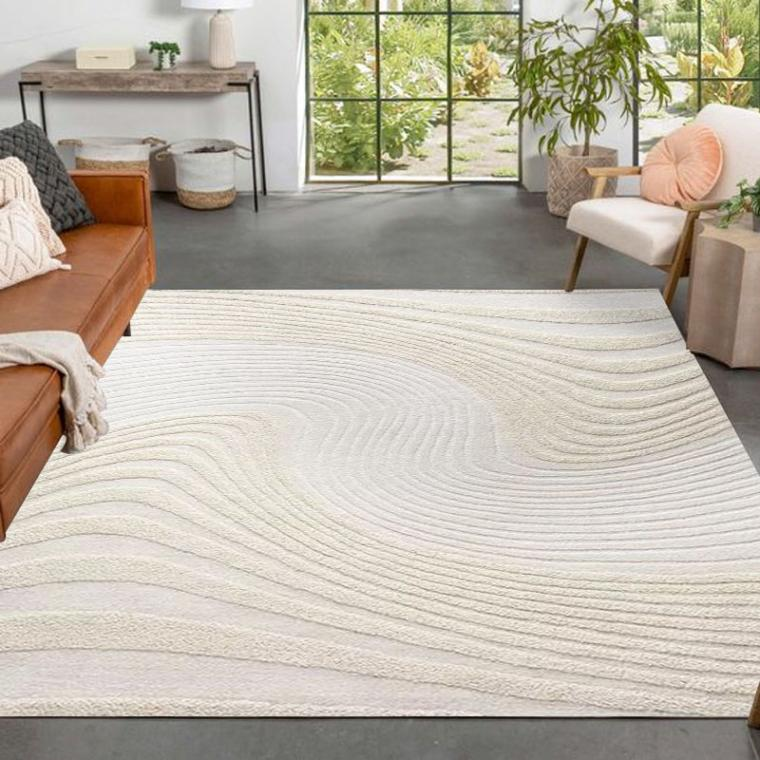
Cut pile creates exposed yarn ends and a soft surface, while loop pile retains closed loops for a more structured texture. Combining cut and loop areas allows visual contrast without changing color.
Pile height can also vary. Raised motifs against a lower background create shadow and depth, while carved channels sharpen pattern edges. Large height differences should be controlled when chairs or furniture need a stable surface.
Turning Artwork Into a Tufted Surface
Digital artwork cannot always be transferred directly into a Hand Tufted Wool Rug. Screens can display fine lines, gradients, and subtle color transitions that may become unclear when translated into yarn, so the design often needs adjustment before production.
Thin lines may need to become wider, neighboring colors may need stronger contrast, and small details may need to be enlarged or removed. Text and logos require particular care because narrow strokes can lose definition after tufting and trimming.
A floor rug is usually viewed from above and at an angle, so large shapes and clear boundaries often read better than extremely intricate detail. Scaled room visualizations can help confirm how the pattern will look once furniture is added.
Color, Light, and Wool Texture
The color of a Hand Tufted Wool Rug can look different from the same color on a digital screen. Screens emit light, while wool reflects light from a textured surface. Pile direction, yarn twist, room lighting, and surrounding finishes can all influence the result.
Physical yarn samples are therefore useful when color accuracy matters. They should be viewed in the intended room under daylight and artificial light. Closely related shades can create subtle depth, while stronger contrast can make carved outlines more visible.
Directional shading is also natural on many pile surfaces. The same yarn may appear lighter or darker from another direction even though its actual color has not changed.
Backing, Placement, and Long-Term Care
The backing system of a Hand Tufted Wool Rug helps secure the tufts and stabilize the construction. Because the yarn is not individually knotted, the integrity of the adhesive and backing layers is important. The rug should not be folded sharply or exposed to conditions that are unsuitable for the backing materials.
For floor use, a suitable rug pad can improve grip on smooth surfaces. Heavy furniture should be positioned carefully, and supports can reduce concentrated pressure from narrow legs.
Vacuuming should suit the pile construction. Carved edges, loops, and raised details may need gentler treatment than a flat surface. Spills should be handled promptly according to the wool and backing care instructions, and excessive moisture should be avoided unless specifically permitted.
Conclusion
A Hand Tufted Wool Rug combines design flexibility with the tactile qualities of wool. Its character is shaped by yarn selection, density, pile height, cut-and-loop structure, carving, color planning, shape, backing, and finishing. The strongest results come from treating these elements as one coordinated system rather than choosing artwork first and construction later.
When the design is adapted to the realities of tufting and the rug is matched to its intended environment, a Hand Tufted Wool Rug can become an integrated interior feature with depth, softness, and clear visual identity. It is this relationship between material, craft, and spatial planning that gives the surface its distinctive character.
Frequently Asked Questions
1. Is a Hand Tufted Wool Rug the same as a hand-knotted rug?
No. A Hand Tufted Wool Rug uses yarn inserted through a primary backing and secured by a backing system, while a hand-knotted rug is built from individually tied knots.
2. Can a Hand Tufted Wool Rug have different pile heights?
Yes. Different pile heights, cut pile, loop pile, and carved channels can be combined to create dimensional texture when the design remains practical for the intended use.
3. Why can a Hand Tufted Wool Rug look lighter from one direction?
Pile direction changes how light reflects from the wool surface, so the same yarn may look lighter or darker from different viewing directions.
4. Does a Hand Tufted Wool Rug need special care?
It should be vacuumed and cleaned according to its wool, pile, and backing construction. Aggressive brushing, excessive moisture, or unsuitable cleaning methods can affect the surface.
Post time: Aug-19-2026


