


A custom tuft rug turns a functional floor covering into a design element created for a particular space, concept, or visual identity. Instead of adjusting an interior around a standard rug size and pattern, customization allows the rug to respond to the room’s dimensions, color palette, furniture arrangement, and intended atmosphere.
Tufting is especially suitable for custom designs because it can produce curved forms, graphic patterns, lettering, logos, illustrations, and areas with different pile heights. These possibilities make a custom tuft rug relevant to homes, studios, hospitality spaces, exhibitions, offices, and decorative installations.
Successful customization requires more than an attractive image. Shape, fiber, density, pile height, edge finishing, color accuracy, and practical use must all be considered during the design process.
Understanding the Tufting Process
Tufted rugs are created by inserting yarn through a prepared backing material. The yarn forms either cut pile, loop pile, or a combination of both. After tufting, the structure is secured with a backing system, and the surface may be trimmed, carved, or finished to refine the design.
This method differs from hand-knotting, where individual knots are tied to build the rug gradually. Tufting generally allows greater freedom when producing bold graphics, irregular shapes, and dimensional textures.
A custom tuft rug can include:
- · Solid color areas
- · Geometric compositions
- · Organic or asymmetrical outlines
- · Text and brand marks
- · Illustrative images
- · Contrasting pile heights
- · Carved lines and raised details
- · Cut-pile and loop-pile combinations
The construction method should support the design rather than merely reproduce it. Some artwork needs simplification so that lines, shapes, and color boundaries remain clear in yarn.
Starting With the Intended Space
Custom rug design should begin with the environment where the rug will be used. A design for a quiet bedroom has different requirements from one placed in a reception area or commercial lounge.
Room measurements should include more than the available floor width and length. Furniture positions, door movement, walking routes, floor outlets, columns, and architectural curves can all affect the final dimensions.
The rug may be designed to:
- · Sit beneath a specific table or seating arrangement
- · Follow the curve of a wall or platform
- · Fill an unusually shaped floor area
- · Create a focal point in an open room
- · Define a functional zone
- · Display a visual symbol or identity
A clear floor plan can prevent proportion problems and ensure that important sections of the design are not hidden beneath furniture.
Translating Artwork Into a Rug Design
Artwork viewed on a screen does not transfer directly into a textile surface. Digital images can contain extremely fine lines, small gradients, and subtle color changes that may be difficult to express clearly through tufted yarn.
The artwork often needs to be adapted by:
- · Increasing the thickness of narrow lines
- · Reducing unnecessary color variations
- · Simplifying complex details
- · Separating shapes more clearly
- · Adjusting contrast between neighboring colors
- · Repositioning key elements away from trimmed edges
The viewing distance also matters. A rug is usually seen from above and at an angle rather than directly in front of the eyes. Large, clear shapes often communicate more effectively than tiny details.
For logos or lettering, the font weight and spacing should be tested carefully. Thin characters may lose clarity, while tightly spaced letters may blend together after tufting and carving.
Shape as Part of the Design
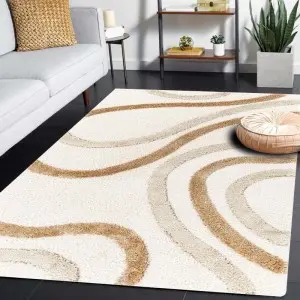
One of the main advantages of a custom tuft rug is the ability to move beyond standard rectangles. Circular, oval, cloud-shaped, floral, abstract, and object-inspired outlines can make the floor part of the visual concept.
An irregular rug shape can soften a room dominated by straight architecture. It can also reflect the form of furniture, artwork, or a brand symbol.
However, complex outlines should remain structurally practical. Very narrow extensions or sharp points may be harder to finish and may experience more wear. Corners and curves should be designed with sufficient width to maintain stability.
The shape must also relate to the surrounding negative space. An expressive outline needs enough exposed floor around it to remain recognizable.
Color Planning and Material Samples
Color is one of the most sensitive areas of custom rug development. Screen colors depend on device settings and illuminated pixels, while yarn colors are affected by fiber texture, direction, pile height, and room lighting.
For this reason, digital color references should be treated as an initial guide rather than an exact physical prediction. Yarn samples can provide a more realistic understanding of the final appearance.
Color planning should consider:
- · Natural daylight in the room
- · Warm or cool artificial lighting
- · Nearby wall and floor colors
- · Upholstery and curtain fabrics
- · The contrast required within the design
- · Possible visual changes caused by pile direction
Dark colors may create strong definition, while pale shades can reveal shadows and surface changes more clearly. Combining several closely related tones may produce depth, but insufficient contrast can make separate forms difficult to distinguish.
Cut Pile, Loop Pile, and Carved Details
Surface construction affects how a custom tuft rug looks and feels. Cut pile creates an even, soft surface with individual yarn ends exposed. Loop pile retains closed loops, producing a more textured and structured appearance.
Combining the two can make selected areas stand out without changing color. A design may use loop pile for a background and cut pile for a central motif, creating visual contrast through texture alone.
Carving introduces channels between shapes or colors. These recessed lines improve definition and can give the rug a sculpted quality. Varying pile heights creates raised sections that interact with light and shadow.
Dimensional effects should be planned carefully. Excessive height differences may affect walking comfort or furniture stability, while subtle differences may not remain visible from a distance.
Fiber Selection and Practical Performance
The fiber should be chosen according to the rug’s purpose. Wool offers softness, resilience, and a substantial appearance. Synthetic yarns may provide strong color consistency and practical maintenance characteristics. Blended constructions may be selected to balance texture, durability, and visual effect.
A decorative wall rug does not experience the same pressure as a floor rug, while an entrance or hospitality rug may need to withstand frequent use. The density, pile height, and backing should therefore match the intended location.
For floor use, edge finishing and non-slip support are important. A suitable rug pad can improve stability and reduce movement on smooth surfaces.
Scale, Proportion, and Visual Balance
A design that looks balanced on a small screen may feel different when enlarged to several meters. Line width, pattern repetition, and empty space all change with scale.
Before production, the design should be reviewed at the intended dimensions. Important questions include whether the central motif is too large, whether border details are too close to the edge, and whether the pattern will remain visible after furniture is added.
A full-size layout or scaled floor visualization can reveal issues that are not obvious in the original artwork.
Conclusion
A custom tuft rug offers extensive control over size, shape, color, texture, and visual identity. Its flexibility makes it suitable for both subtle interior coordination and highly expressive design concepts.
The strongest results come from balancing creativity with construction requirements. Artwork must be adapted for yarn, proportions must suit the room, colors should be evaluated physically, and pile structure should support the intended use. When these factors are considered together, a custom rug can become an integrated part of the space rather than a decorative addition placed on top of it.
Frequently Asked Questions
1. Can a custom tuft rug have an irregular shape?
Yes. Tufting can support many organic and geometric outlines, although extremely narrow sections or sharp points may need adjustment for strength and cleaner finishing.
2. Can photographs be converted into tufted rug designs?
Photographs can be adapted, but complex shading and fine details usually need simplification. Clear shapes and controlled color areas tend to produce stronger textile results.
3. What is the difference between cut pile and loop pile?
Cut pile exposes the ends of the yarn and creates a soft surface. Loop pile keeps the yarn loops closed, producing a more structured texture. Both can be combined in one rug.
4. Why can yarn colors look different from screen colors?
Screens produce color through light, while yarn reflects light from a textured physical surface. Fiber type, pile direction, room lighting, and surrounding colors can all affect the final appearance.
Post time: Jul-30-2026


