


Office carpet tiles provide a modular flooring system that can respond to changing layouts, concentrated wear, acoustic needs, and the visual identity of a workplace. Unlike broadloom carpet, which is installed in large continuous sections, carpet tiles are produced as individual modules. This format makes it possible to combine colors, replace selected areas, and organize a floor around workstations, meeting rooms, corridors, and shared spaces.
Modularity does not automatically make every tile suitable for every office. The backing, pile construction, installation method, traffic classification, chair movement, cleaning program, and condition of the subfloor all influence performance. A successful office floor therefore begins with practical planning rather than pattern selection alone.
A Modular Approach to Changing Layouts
Modern workplaces often change as teams expand, departments move, or furniture systems are reconfigured. Carpet tiles can support these adjustments because the floor is divided into manageable units rather than one uninterrupted surface.
When a local area becomes damaged or permanently stained, selected tiles may be lifted and replaced without removing the entire floor. This can reduce disruption, provided compatible replacement tiles remain available and the surrounding installation is still in good condition. Keeping a small quantity of spare material from the original production run is useful because later batches may show slight color differences.
Zoning the Workplace Through Color and Direction
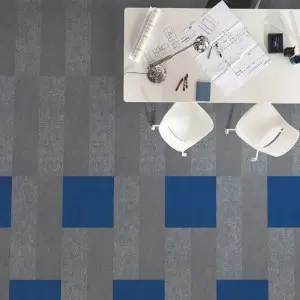
Office carpet tiles can help communicate how a workplace is organized. Different colors or installation directions may identify circulation routes, informal collaboration areas, focused work zones, or meeting spaces without adding physical partitions.
A restrained zoning system is usually more effective than excessive variation. For example, one neutral tile may cover the main work area, while a related darker tone marks primary walkways. A limited accent color can identify reception or breakout areas. When too many colors and patterns compete across the floor, visual guidance becomes less clear.
Tile orientation creates another design tool. Quarter-turn installation produces a subtle checkerboard effect as the pile direction changes. Monolithic installation aligns every tile in the same direction for a more continuous appearance. Ashlar and brick layouts offset the joints and can create movement across long spaces. Not every product supports every installation method, so the approved pattern should be confirmed before work begins.
Supporting Acoustic Comfort
Noise control is an important part of workplace comfort. Hard floors reflect footsteps, rolling-chair sound, and general activity, while textile flooring can absorb some sound within the room and reduce the sharpness of impact noise.
Carpet tiles are not a complete acoustic solution. Ceiling systems, wall treatments, furniture, partitions, building services, and room geometry also influence sound. However, the floor can contribute to an acoustic strategy, particularly in open offices where many people work within one large area.
Tiles with thicker cushion backing may provide different acoustic and underfoot characteristics from products with a firm, compact backing. Product test data should be reviewed when a project has specific acoustic targets. Descriptive terms such as “quiet” or “soft” are not a substitute for measured performance.
Construction for Traffic and Rolling Chairs
Office floors experience repeated movement from footwear, task chairs, carts, and furniture. The most suitable tile is not always the softest product. Dense, low-profile constructions often perform well beneath rolling chairs and in busy circulation zones because the surface offers less resistance and is easier to maintain.
Loop-pile carpet tiles are common in commercial interiors because they can provide a structured surface and strong visual consistency. Cut-pile tiles offer a softer appearance but may show changes in pile direction or pressure more clearly. Hybrid constructions combine different surface effects for texture and pattern.
Chair casters should be compatible with textile flooring, and damaged or unsuitable wheels can cause unnecessary wear. In areas with continuous rolling movement, chair mats may be considered where appropriate, although they can alter the visual continuity of the floor.
Entrances require particular attention because grit and moisture brought in from outside can quickly affect nearby tiles. A properly sized entrance matting system can capture much of this material before it reaches the main carpeted area.
Subfloor Preparation and Installation
Carpet tiles depend on a flat, clean, dry, and stable subfloor. Modular products can follow imperfections in the surface below, so visible joints or uneven edges may result when preparation is inadequate. Moisture conditions should be tested according to the requirements of the flooring and adhesive systems.
Installation methods vary. Some tiles use pressure-sensitive adhesive across the full area, while others use tabs, corner connectors, or manufacturer-specific systems. The method affects removability, stability, access, and future replacement. It should be selected according to the product specification rather than improvised on site.
A layout plan is especially important around walls, columns, doors, floor boxes, and glass partitions. Starting from an unsuitable reference line can produce narrow cuts along visible edges. Dry laying a sample area allows the direction, joint pattern, and color distribution to be checked before installation continues.
Maintenance and Selective Replacement
A maintenance program should reflect the way each office zone is used. Main entrances and corridors usually require more frequent attention than enclosed rooms. Regular vacuuming removes dry soil before it is ground into the yarn, while prompt spot cleaning limits the spread of spills.
Cleaning products and equipment should match the fiber, backing, and adhesive system. Excessive moisture can create longer drying times or affect the installation. Periodic deep cleaning may be required, but the method should follow the flooring manufacturer’s guidance.
One advantage of tiles is the possibility of rotating or replacing selected modules. A tile that has become visually worn can sometimes be moved to a less prominent position, provided its condition and installation allow this. Permanent stains or physical damage may be addressed by replacing only the affected unit. Replacement tiles should be installed in the correct direction and allowed to settle visually with the surrounding floor.
Conclusion
Office carpet tiles combine modularity with opportunities for acoustic support, visual zoning, and adaptable workplace planning. Their long-term performance depends on choosing a construction suitable for traffic, preparing the subfloor correctly, following the approved installation direction, and maintaining each zone according to use.
When these factors are considered together, the floor can accommodate organizational change without appearing temporary.
Frequently Asked Questions
1. Can individual office carpet tiles be replaced?
Yes, selected tiles can often be replaced when they are stained or damaged. Compatible spare tiles should be stored from the original installation because color and texture can vary between production batches.
2. Are carpet tiles suitable for rolling office chairs?
Many commercial carpet tiles are designed for office use, but the pile, density, backing, and chair casters must be suitable for repeated rolling. Product classifications should be checked for the intended traffic level.
3. Do office carpet tiles reduce noise?
Textile flooring can reduce the sharpness of footsteps and some room sound compared with hard surfaces. It should still be treated as one element within a complete acoustic plan rather than a standalone solution.
4. What installation pattern is best for carpet tiles?
The best pattern depends on the product and design objective. Monolithic, quarter-turn, ashlar, and brick layouts create different effects, but only installation methods approved for the selected tile should be used.
Post time: Aug-05-2026


