


Dining Room Rugs can change the way a dining space looks, sounds, and functions without altering the table or chairs themselves. By creating a defined surface beneath the dining set, Dining Room Rugs help organize the room visually, soften hard flooring, and introduce color or texture where furniture alone may feel too rigid. In open-plan interiors, Dining Room Rugs can also separate the dining zone from nearby living or kitchen areas while keeping the overall layout connected.
The most successful result depends on more than choosing a pattern that looks attractive. Dining Room Rugs must work with chair movement, table proportions, daily cleaning, floor protection, and the amount of traffic around the space. Size, material, pile height, shape, and placement all influence whether the dining area feels balanced and practical over time.
Sizing Dining Room Rugs Around the Table and Chairs
Size is one of the most important decisions when planning Dining Room Rugs. A rug that ends too close to the table can create an awkward edge under the chair legs. When a chair is pulled backward, the rear legs may slide off the rug and catch on the edge when the chair moves forward again. A larger surface allows the chairs to remain supported during normal use.
The correct dimensions depend on the table size, chair depth, and available floor area. Rather than measuring only the tabletop, measure the complete dining arrangement and allow additional space for chairs to move backward.
Rectangular tables often work naturally with rectangular Dining Room Rugs, while round tables can suit round or square designs. The shape does not have to copy the table exactly, but the relationship should look intentional. Marking the proposed dimensions on the floor with removable tape can help confirm walkways and visual balance before making a final decision.
Material Choices for Food, Foot Traffic, and Furniture
Dining Room Rugs are exposed to chair movement, crumbs, occasional spills, and repeated foot traffic, so material selection should balance comfort with maintenance. A delicate surface may look refined but can become difficult to manage when the dining area is used every day.
Wool is valued for resilience, natural texture, and recovery from compression. Synthetic fibers may offer consistent color and straightforward maintenance, while blended constructions can combine different characteristics. Dense construction is generally useful beneath dining furniture because chair legs concentrate pressure in small areas. A suitable rug pad can also reduce movement on smooth timber, stone, or tile floors.
The best material for Dining Room Rugs therefore depends on real use: meal frequency, children or pets, cleaning routine, chair weight, and the level of traffic around the table.
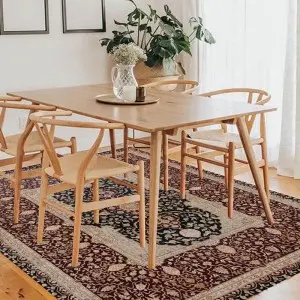
Pile Height and Chair Movement
Pile height changes how Dining Room Rugs feel and how easily chairs move across the surface. Low-pile and flatwoven constructions usually allow chair legs to move with less resistance and are often easier to vacuum around the dining area. They also reduce the chance of food particles becoming deeply trapped between longer fibers.
Medium-pile options can add more softness while still remaining practical when the construction is dense and stable. Very deep pile creates a plush appearance, but it can make dining chairs harder to move and may show compression more clearly beneath chair and table legs.
The edge profile is also important. Thick borders, raised decorative edges, or uneven sculpted details should not sit where chairs are repeatedly pulled back. If dimensional texture is part of the design, it is usually better when the main chair movement stays on a relatively consistent surface.
Using Color and Pattern to Support the Dining Area
Dining Room Rugs can become the visual focus of the room or create a quiet base for furniture and lighting. Patterned surfaces are useful in dining areas because they add depth and can make small marks less visually obvious than a completely plain, pale surface.
Geometric patterns can support contemporary interiors, while traditional, abstract, botanical, striped, or tonal designs can connect colors already present in curtains, walls, table settings, or artwork. The rug does not need to match the dining chairs exactly; repeating two or three surrounding colors is often enough to create continuity.
Pattern scale should suit the room. Large motifs may be partly hidden by the table, while smaller repeats remain visible around the edges. Consider which areas of Dining Room Rugs will actually remain exposed after all furniture is in position.
Conclusion
Dining Room Rugs provide more than decoration. They help establish proportion around the dining table, soften hard flooring, reduce visual emptiness, support zoning in open-plan spaces, and create an opportunity to introduce color and texture. Their success depends on choosing dimensions that accommodate chair movement, materials that suit daily use, and a surface structure that can be maintained realistically.
By planning Dining Room Rugs around the full dining arrangement rather than the table alone, the floor becomes an active part of the room design. A well-proportioned and carefully maintained rug can make the dining space feel more comfortable, connected, and complete.
Frequently Asked Questions
1. How large should Dining Room Rugs be?
Dining Room Rugs should extend far enough beyond the table for chairs to remain supported when pulled back during normal use. Exact dimensions depend on the table, chair depth, and available floor area.
2. Are low-pile Dining Room Rugs practical?
Yes. Low-pile Dining Room Rugs are generally easier to vacuum and allow dining chairs to move with less resistance than very deep-pile surfaces.
3. Can Dining Room Rugs be used under round tables?
Yes. Round tables can work with round, square, or sufficiently large rectangular Dining Room Rugs when the proportions and chair clearance are balanced.
4. Do Dining Room Rugs need a rug pad?
A suitable rug pad can improve stability and reduce movement. It should be compatible with both the rug construction and the flooring material.
Post time: Aug-17-2026


